Average Reviews:

(More customer reviews)Are you looking to buy The Elegant Solution: Toyota's Formula for Mastering Innovation? Here is the right place to find the great deals. we can offer discounts of up to 90% on The Elegant Solution: Toyota's Formula for Mastering Innovation. Check out the link below:
>> Click Here to See Compare Prices and Get the Best Offers
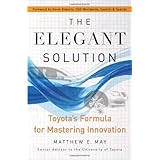
The Elegant Solution: Toyota's Formula for Mastering Innovation ReviewI highly recommend his book to all who want to practice innovation as a way of doing business. In the foreword, Kevin Roberts writes that Toyota is "the quintessential postindustrial organization" which has "a highly structured and systematized culture that is also a hotbed of individual creativity." Matthew May was hired by Toyota Motor Sales, U.S.A., Inc. to design and deliver education for the University of Toyota that would translate the innovative methods of the Toyota Production System into something that could be used by knowledge workers. It took May five years to accomplish the process. According to May, at Toyota it is the quest for the elegant solution the shapes true innovation. In his book, May not only defines the elegant solution but also tells the reader how to achieve innovation in his or her own work.In addition to Kevin Roberts' foreword The Elegant Solution contains the following chapter divisions:
Backstory: One Million Ideas
Introduction: In Search of Elegance
Part 1: Principles
1. The Art of Ingenuity
2. The Pursuit of Perfection
3. The Rhythm of Fit
Part 2: Practices
4. Let Learning Lead
5. Learn to See
6. Design for Today
7. Think in Pictures
8. Capture the Intangible
9. Leverage the Limits
10. Master the Tension
11. Run the Numbers
12. Make Kaizen Mandatory
13. Keep it Lean
Part 3. Protocol
14. The Clamshell Strategy
15. The Elegant Solution
Afterword: Word of Encouragement
In his Backstory: One Million Ideas, May writes that the world needs his book on innovation because it needs a book that is different, that looks at innovation in a new way and that helps with us with our daily work. May tells us that Toyota "implements a million ideas a year." In May's opinion the one million business ideas implemented each year is why Toyota's market value is larger than GM, Ford, Daimler-Chrysler, Honda and Volkswagen combined. May's basic proposition is that the "quest for the elegant solution shapes true innovation." He says that the "formula for the solution is an amalgam of principles, practices and protocol." But the individual parts are not new. It is "Toyota's remarkable ability to collectively and completely master all of them as a way of life" that makes Toyota unique.
Introduction: In Search of Elegance
In his introduction May tells the story of Sakichi Toyoda, the founder of Toyoda Automatic Loom Works, the precursor of the Toyota Motor Company. Toyoda's story is "about one man's nearly spiritual quest to solve a very real problem facing the world around him." The underlying principals that Toyoda followed were Ingenuity in Craft, Pursuit of Perfection and Fit with Society. It is these principles that "fuel the engine of innovation at Toyota." May says that simple solutions are better, and elegant solutions are better still. He describes the elegant solution as "finding the aha solution to a problem with the greatest parsimony of effort and expense."
Chapter 1: The Art of Ingenuity
May tells us that even though some in the business press are saying that innovation in America is becoming extinct because of outsourcing, "there's a slowly rising tide of creativity among today's workforce. More and more, people are beginning to return to the almost forgotten Renaissance era of mastery. They're adopting a different view of their work ... people are beginning to see themselves as artists and scientists, or more accurately business artists and business scientists." According to May, the business world today demands this change. That because of recent events people have become disenchanted with business and need a new way to work, a new perspective. The new way is creative license. This new way of working at innovation is an applied creativity. May sees applied creativity as ingenuity and says that it has two sides - Engagement and Exploration.
Chapter 2 - The Pursuit of Perfection
In this chapter, May describes the pursuit of perfection as discipline of increments. He shows how we have come to expect and accept mediocrity instead of perfection. But there are companies that don't accept mediocrity, but pursue perfection. He lists Toyota, Apple, Gore and GE. May maintains that elegant solutions "demand optimizing quality, cost and speed. They're the three primary tangible drivers of customer value in all goods and services." He says that our culture is fishing for the red herring, the big idea. And that this keeps us from focusing on the real work of innovation. He claims that the big earth-shattering ideas rarely work at first that it takes innovators to "shape them into something actually workable." May uses the example of the mouse and icon system interface. Xerox conceived it, but it was Apple that made it work commercially. He maintains that the kind of discipline needed for the pursuit of perfection "requires a fundamental mindshift." How it is not big leaps but it is small steps.
Chapter 3: The Rhythm of Fit.
In this chapter May explains how our innovations must fit with the needs of society. How they must be "the right thing, at the right time in the right form, for the right people." In order to accomplish this fit, May writes that we need to employ systems thinking. We must provide solutions within the current context or we must provide a new context. He uses the example of Thomas Edison designing the entire electrical system in order to provide the context for his light bulb. Without systems thinking, May points out that we can have major failure such as the United Airline automated baggage system at Denver International Airport which delayed the opening of the airport for a year and caused the airline ten painful years of operation as it regularly damaged or lost luggage, and the disaster in New Orleans after Hurricane Katrina. May says that every solution has three dimensions - solid structure, strong systems and social significance. That great innovation must focus on each dimension. That we cannot think outside of the box. If our thinking will not fit in the box, we must build a new box.
Chapter 4: Let Learning Lead
In this chapter, May tells us that while learning and innovation "go hand in hand" the learning must come before there can be innovation. It is through learning that ideas are converted into action. He says that it is accomplished through a cycle of steps. And that cycle of steps is The Scientific Method: Questioning, Solving, Experimenting, And Reflecting. There are several other versions of the cycle. Walter Shewhart called it Plan, Do, Study, Act or PDSA. Dr. W. Edward Deming taught it to the Japanese after World War II and changed it to Plan, Do, Check, Act or PDCA. Capt. John Boyd, a U.S. Air Force fighter pilot called it Observe, Orient, Decide, Act or OODA. The Department of Defense uses it in its Spiral Development process. Police forces call it Scan, Analyze, Respond, Assess or SARA. But they are all just variations on the same cycle of learning. May gives us his version of the cycle as a tool. He calls his version I.D.E.A. Loops - a learning cycle for innovation. His cycle is Investigate, Design, Execute, and Adjust. As he brings the chapter to a close, May describes the Japanese practice of Hansei, which means reflection. It is a process conducted in a meeting after a project is completed to perform a rigorous review of the project to see what can be learned. He notes that the U.S. Army practices hansei in its After Action Reviews.
Chapter 5: Learn to See
In this chapter, May describes the process of genchi genbutsu or go and see. It is part of the Investigate phase of the cycle. He tells us that in order to understand the problem we have to go and see it from the customer's perspective. Only then can we define the problem and design a solution. During genchi genbutsu Toyota uses three ways to understand the problem: "Observe or watch the customer, Infiltrate or become the customer, and Collaborate or involve the customer." May says that if we don't perform this part of the process we risk the "ivory tower peril of basing strategic innovation on prevailing market assumptions and consumer research reports." This led to such great projects as the Ford Edsel.
Chapter 6: Design for Today
May warns that our designs must "focus on clear and present needs." We can "mistake invention for innovation, with the missing link being the principle of fit with society." He describes how to design for today while acting for tomorrow. It is discovering a need that has not been met. He tells us that innovation comes by design and when companies outsource design they outsource innovation. He then shows us how Toyota keeps all of its design in-house. For Toyota, it is a matter of principle, ingenuity of craft. May describes how Toyota used this method to gain market dominance in hybrid technology. Toyota also used this method to exploit a demographic shift to create the Scion brand. The Scion brand is designed to reach out to "the 60 million Generation Y crowd." Toyota innovated today in order to survive tomorrow. To design for today you must have "a firm grasp of the market, society and the customer."
Chapter 7: Think in Pictures
In this chapter, May describes how to add a visual element to our designs. He says, "the value of mental imagery and visualization in driving performance is undisputed." He gives us examples of from great visionaries like Walt Disney, Winston Churchill, Henry Ford and Martin Luther King Jr. Pictures and images can be used to "connect people to the intention in a very forceful way, touching hearts and minds." Toyota makes use of these tools in everything it does.
Chapter 8: Capture the Intangible
May writes that the "most...Read more›The Elegant Solution: Toyota's Formula for Mastering Innovation Overview
Want to learn more information about The Elegant Solution: Toyota's Formula for Mastering Innovation?
>> Click Here to See All Customer Reviews & Ratings Now

0 comments:
Post a Comment