Average Reviews:

(More customer reviews)Are you looking to buy Margrethe Mather and Edward Weston: A Passionate Collaboration? Here is the right place to find the great deals. we can offer discounts of up to 90% on Margrethe Mather and Edward Weston: A Passionate Collaboration. Check out the link below:
>> Click Here to See Compare Prices and Get the Best Offers
Margrethe Mather and Edward Weston: A Passionate Collaboration ReviewAlmost nothing has been written on the pictorialist movement in California in the early 20th century, yet every well know photographer in California was active in it. This book is an imaginative look at one of the best and most mysterious practitioners. Mather and Weston found themselves in L.A. at the time in history when the movie industry was taking shape and a lot of creative and adventurous people came out here. This book captures some of that atmosphere.Mather is interesting as a woman, as an artist and member of an eclectic group of West Coast artists, one of whom was Edward Weston with whom she worked and did other things for about 12 years. There is no question that they stimulated each other. Nothing could be less important except to get you to buy a book, I think.
Warren weakens Mather by linking her to Weston, trying to make the case that she influenced him. Her analysis is superficial to the point that her writing seems like an "infomercial". This is not surprising since the author used to work for an art auction house.
She would be far more informative if she had pointed out the differences between their approaches to the same subjects. Artists, particularly photographers of the place and time in question, met each other in clubs where they showed each other their work and talked about it. Everyone knew everyone and their influences helped define the differences between them. The Impressionists hung out together, the Dadaist hung out together as did almost every group or movement in art history. It is not informative for the author simply to restate this commonplace.
One of Mather's photographs of a boy wrapped in a kimono Warren compares with Weston's photograph of Tina Modotti in a kimono taken some years later. The subject is not new, and both photographs are wonderful but entirely different. Mather's is graphically 30 years ahead of its time, abstract, soft and easy.
Weston's is bold, sharp and explicit, and a dramatic break with pictorialism. It was probably influenced by Stieglitz, not Mather, according to those who wrote about Weston's meeting with Stieglitz. These two pictures, like many of the others Warren compares, are not even about the same thing.
In the end, this is a book about Edward Weston and not Mather. No new light is shed on either one of them, despite the huge bibliography of reference material. Not all of the works listed support Warren's case but she never mentions this of course.
There is a lot of art in this biography but not much art history. The photographs are well selected and presented. Margrethe Mather made some exceptional photographs which brought her a just amount of fame.
Mather's personal life would make a good movie. She was beautiful, talented and led a mysterious life which ended somewhat tragically. She died unknown mostly because she wanted to, and that is an important part of her story which Warren explores in this book.
Warren is working on a longer treatment of Mather. Hopefully she will pay more attention to the substance of the artist's work and her personal life and distract us less with her association with Weston.
This book is graphically rich and stimulating food for thought. Buy if for the art and dig up some of the material referred to in the footnotes.Margrethe Mather and Edward Weston: A Passionate Collaboration Overview
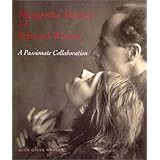
An examination of the personal and professionalrelationship between two important Americanphotographers.
Margrethe Mather has been remembered mostlythrough the commentary of fellow photographerEdward Weston, who referred to her as "thefirst important person" in his life. Infact, Mather was probably the greatest influence on the development of Weston's early career.Although Mather's little-known body of work has always held its own in the company of greatphotographs, her biography and influence havenever been thoroughly investigated, in no smallpart due to her own reluctance to reveal thedetails of her colorful, sometimes sordid life.This book illuminates the professional andpersonal relationship of Mather and Weston,adding an unforgettable chapter to the historyof twentieth-century photography.Mather andWeston first met in Los Angeles in 1913. Theysoon developed a close relationship, eventuallyworking together as full-fledged artisticpartners and even co-signing the photographsthey produced. Weston was also madly in lovewith Mather, and the two engaged in a briefaffair during his first marriage, althoughMather was more interested in women. This book,which features work by both artists, chroniclestheir twelve-year association and sheds light on Mather, whose artistry, sexual identity, andmysterious past were overshadowed by the massive reputation of Edward Weston and his subsequentassociation with Tina Modotti.
Want to learn more information about Margrethe Mather and Edward Weston: A Passionate Collaboration?
>> Click Here to See All Customer Reviews & Ratings Now